

Table of Contents
Google Pixel 10a is shaping up as one of the most balanced mid‑range phones of 2026, especially if camera quality, clean software, and long‑term AI support are your priorities. This detailed Google Pixel 10a Review breaks down real‑world strengths, weaknesses, pricing, and whether you should buy it over the Pixel 9a and top rivals from Samsung and OnePlus.
Google Pixel 10a Review: Quick Summary
- Premium camera performance with a 48 MP main sensor and classic Pixel computational photography.
- 6.3‑inch 120 Hz OLED “Actua‑style” display with Gorilla Glass 7i at a mid‑range price.
- Google Tensor G4, 8 GB LPDDR5X RAM, and 128/256 GB UFS 3.1 storage for smooth day‑to‑day use.
- 5100 mAh battery with fast wired and wireless charging, tuned for all‑day endurance.
- Seven years of Android + security updates and deep AI features integrated across the UI.
Design, Build, and Display
Google sticks to the Pixel design language with the recognizable horizontal camera bar and minimalist back panel, now using Gorilla Glass 7i on the front and a recycled plastic rear for durability with reduced weight. The Pixel 10a comes in Obsidian, Fog, Lavender, and Berry, giving buyers more playful color options than most serious‑looking mid‑rangers.
The 6.3‑inch OLED panel runs at 2424 × 1080 resolution with a 120 Hz refresh rate and high peak brightness (up to around 3000 nits), making it sharp enough for media and smooth for scrolling even outdoors. Google’s Actua‑like tuning prioritizes natural color reproduction over punchy oversaturation, which many creators and professionals prefer.
Google Pixel 10a Specs: Hardware Overview
At the heart of this Google Pixel 10a Review is the hardware stack and how it translates to real‑world experience. The phone is powered by the Google Tensor G4, backed by the Titan M2 security chip, 8 GB LPDDR5X RAM, and 128 GB or 256 GB UFS 3.1 storage with no microSD slot.
Key Google Pixel 10a Specs:
- SoC: Google Tensor G4 (4 nm), octa‑core X4‑based CPU, Mali‑G715 MC7 GPU.
- RAM: 8 GB LPDDR5X.
- Storage: 128 GB / 256 GB UFS 3.1 (no expansion).
- Display: 6.3‑inch OLED, 2424 × 1080, 120 Hz, Gorilla Glass 7i.
- Battery: ~5100 mAh with fast charging and wireless charging support.
- Security: Titan M2, under‑display fingerprint, Face Unlock.
- Connectivity: 5G SA/NSA, Wi‑Fi 7, Bluetooth 6.0, NFC, USB‑C.
Tensor G4 isn’t the benchmark king next to Snapdragon 8 Gen 5/8s Gen 3, but it is tuned for AI workloads, image processing, and on‑device ML use‑cases rather than pure gaming. For typical users, this means stable performance for social apps, camera use, and multitasking, with only heavy 3D titles exposing its limitations versus more gaming‑oriented chips.
Google Pixel 10a Camera: Still the Mid‑range Benchmark?
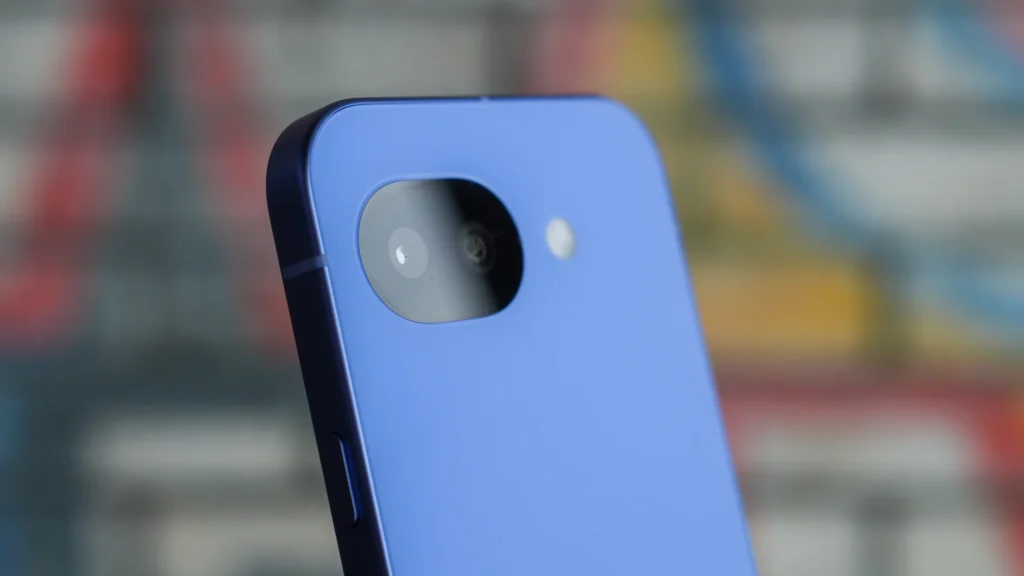
If you are reading this Google Pixel 10a Review primarily for camera performance, this is where the device justifies its price.
Rear Camera Hardware
The Pixel 10a features a dual‑camera system:
- 48 MP main camera, f/1.7, OIS, PDAF, 1/2″ sensor, 0.8 µm pixels.
- 13 MP ultra‑wide, f/2.2, 1/3.1″ sensor, 1.12 µm pixels.
- Dual‑LED flash, 4K at 60 fps video on the rear camera.
While some rivals pack triple or quad cameras, many of those extra sensors are low‑quality macro or depth modules; Google focuses on two high‑quality lenses and lets computational photography handle the rest.
Image Quality and Computational Tricks
Thanks to Tensor G4 and Google’s imaging pipeline, the Pixel 10a continues the “point‑and‑shoot and get a good shot” tradition.
Expected strengths:
- Excellent dynamic range and highlight recovery due to HDR+ and multi‑frame stacking.
- Realistic skin tones with Google’s Real Tone improvements refined over generations.
- Strong low‑light performance with Night Sight, especially on the main camera.
- Accurate, contrast‑rich portraits with subject isolation that beats most mid‑range competitors.
Video gets a boost with 4K at 60 fps on the rear camera and improved stabilization leveraging both OIS and EIS. For casual vloggers or social creators, this makes the Pixel 10a one of the most content‑ready phones at its price.
Front Camera
The front shooter is a 13 MP sensor capable of 4K at 30 fps, improving both selfie detail and front‑camera video quality for Reels, Shorts, and video calls. Google’s software adds features like background blur and improved face detection even in low light, again powered by Tensor’s on‑device ML.
Google Pixel 10a AI Features and Software Support
One of the biggest reasons to buy the Pixel 10a is its combination of Pixel‑exclusive AI features and long software support. This section of the Google Pixel 10a Review focuses on how AI actually changes daily use, beyond marketing buzzwords.
On‑device AI Features
Tensor G4 is built around AI, and Google leverages that for features such as:
- Advanced Call Screen and Hold for Me to handle spam and waiting on calls.
- Circle to Search and AI‑powered copy‑assist right from the navigation bar.
- Live Translate and Interpreter mode for real‑time translations in chats and calls.
- Magic Editor and Magic Eraser for photos, allowing object removal, recomposition, and lighting tweaks.
- Audio Eraser and improved speech‑to‑text for recording and captions.
Because these run heavily on‑device, they are faster and more privacy‑friendly than cloud‑only solutions. Over time, Google tends to backport new AI tricks to older Pixels, but the latest and most efficient features are first‑class on the 10a.
Google Pixel 10a Software Support
The Pixel 10a ships with the latest Android build (Android 15/16 series, depending on market timing) with a clean Pixel UI and zero heavy bloatware. Google is promising around seven years of OS and security updates in line with the recent Pixel policy, which is remarkable in this segment.
For users in the USA, India, and Europe, that means you can safely keep the Pixel 10a as your primary device for much longer than most Android mid‑rangers, with timely feature drops and monthly patches. This long Google Pixel 10a Software support is a key reason to pick it over spec‑heavy but short‑lived alternatives.
Google Pixel 10a Battery and Charging
Battery life is another central pillar of this Google Pixel 10a Review because Tensor devices used to struggle a bit here in earlier generations. Google has clearly course‑corrected with a 5100 mAh cell and better power optimization.
Real‑world Endurance
- 5100 mAh capacity supports well over a full day of moderate to heavy use, including social media, photography, and navigation.
- Adaptive Battery and AI‑based optimization learn your usage patterns to prioritize frequently used apps and limit background drain.
While some rivals such as OnePlus 15R and a few Realme/Vivo models, boast 6500–7400 mAh cells, the Pixel 10a keeps its weight in check while still delivering comfortable all‑day endurance.
Charging Experience
The Pixel 10a supports fast wired charging and wireless charging (around 7.5–15 W depending on region and accessories). You do not get the super‑fast 80–100 W speeds of some Chinese brands, but Google focuses on battery health and consistency over time. For most users, a top‑up during the day plus overnight wireless charging will be more than enough.
Google Pixel 10a Price: USA, India, and Europe
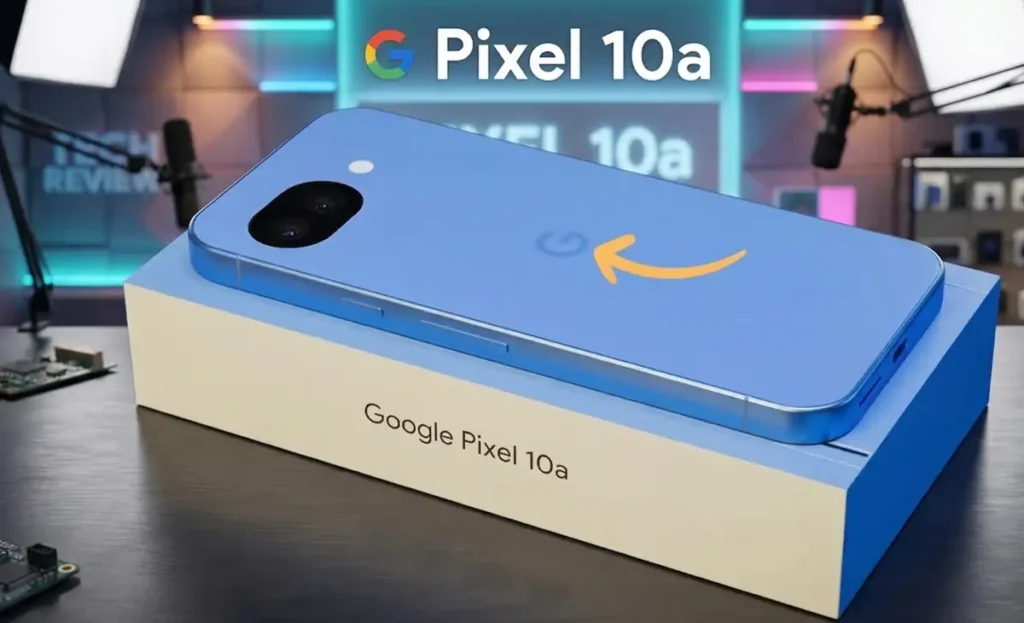
Pricing is critical to this Google Pixel 10a Review because it determines whether the package truly beats its competition.
Based on official listings and trusted retailer leaks, here’s where the Google Pixel 10a Price lands:
- USA: About 499 USD for 8/128 GB, with higher for 256 GB.
- Europe: 499 EUR (128 GB), 599 EUR (256 GB) in major EU markets.
- UK: Around 499 GBP starting price.
- India: Expected starting at roughly ₹49,999 for 128 GB, with 256 GB reaching ₹59,999–₹69,999 depending on launch offers and region.
- Canada: Around 679 CAD.
This positions the Pixel 10a slightly higher than aggressive Chinese competitors but aligned with upper‑mid‑range offerings from Samsung and OnePlus. The value proposition leans heavily on camera quality, clean software, and long updates rather than raw spec sheets.
Pixel 10a vs Pixel 9a vs Rivals: Specs and Price Compared
To make this Google Pixel 10a Review actionable, we compare it directly with the Pixel 9a and two key mid‑range competitors: OnePlus Nord 5 (global) and Samsung Galaxy A56 (India‑centric pricing).
Core Specifications and Price Comparison
| Phone | SoC | RAM / Storage | Display | Rear Camera | Battery | Approx Price* |
|---|---|---|---|---|---|---|
| Google Pixel 10a | Tensor G4 (4 nm) | 8 GB + 128/256 GB | 6.3″ OLED, 2424×1080, 120 Hz | 48 MP + 13 MP | 5100 mAh | $499 / €499 / ₹49,999 |
| Google Pixel 9a | Tensor G4 (4 nm) | 8 GB + 128/256 GB | 6.3″ OLED, 1080×2424, 120 Hz | 48 MP + 13 MP | 5100 mAh | ~$270 / €368 / ₹39,999 |
| OnePlus Nord 5 | Snapdragon 8s Gen 3 | 8 GB + 256 GB | 6.8″ AMOLED, 2800×1272, 144 Hz | 50 MP + 8 MP | 5200 mAh | Varies (upper mid‑range) |
| Samsung Galaxy A56 | Exynos / Snapdragon mid‑range | Up to 8/256 GB | ~6.6″ AMOLED, 120 Hz | 50 MP triple cam | 5000+ mAh | Around ₹43,999 in India |
*Prices are indicative and can vary by market, offers, and storage variant.
Key Takeaways from the Comparison
- If you’re upgrading from Pixel 9a, the Pixel 10a brings newer connectivity (Wi‑Fi 7, Bluetooth 6), a slightly refined design, updated AI features, and better brightness, but the overall hardware profile is iterative rather than revolutionary.
- OnePlus Nord 5 and Samsung Galaxy A56 offer higher refresh or larger displays and more performance‑oriented SoCs, which gamers will notice.
- None of the competitors, however, match Pixel’s blend of camera consistency, clean UI, and seven‑year update promise.
For buyers choosing between Google Pixel 10a vs Google Pixel 9a, the decision often comes down to budget and how much you value the latest AI features and minor hardware refinements over saving a significant amount with the 9a.
Real‑World Use: Who Is Pixel 10a For?
This section of the Google Pixel 10a Review focuses less on specs and more on fit. The Pixel 10a is ideal if you fall into one of these profiles:
- Photography‑first users who want the most reliable point‑and‑shoot camera in the mid‑range segment.
- Professionals and students who prefer a clean Android experience with guaranteed long updates.
- Users in USA, India, and Europe who rely heavily on Google’s ecosystem (Gmail, Drive, Photos, Docs) and want the “Google‑first” experience.
- Non‑gamers or light gamers who care more about smooth everyday use and great photos than the highest FPS in heavy titles.
On the other hand, heavy gamers or users who care about ultra‑fast charging and giant screens might find better value in devices like the OnePlus 15R, Nord 5, or some Realme/Vivo options.
Why You Should (or Shouldn’t) Buy the Pixel 10a
To conclude the main body of this Google Pixel 10a Review, here are clear reasons to buy or skip the phone.
Reasons to Buy Google Pixel 10a
- Class‑leading camera experience in photos and competitive video for the price.
- Long Google Pixel 10a Software support with around seven years of OS and security updates.
- Pixel‑exclusive Google Pixel 10a AI features are tightly integrated into the UI for calls, photos, translations, and search.
- Clean, bloat‑free Android with regular feature drops, ideal for both power users and casual buyers.
- Strong Google Pixel 10a battery life with a 5100 mAh cell and wireless charging support.
Reasons to Skip Google Pixel 10a
- Tensor G4 is not the best chip for sustained heavy gaming compared to Snapdragon 8 Gen 5/8s Gen 3 rivals.
- Charging speeds are conservative compared to 80–100 W fast charging phones in the same bracket.
- No expandable storage, so 128 GB may feel tight for power users with large media libraries.
- Some markets may see aggressive pricing from Chinese brands that undercut the Pixel 10a by a wide margin.
Conclusion: Is Google Pixel 10a Worth It in 2026?
The Google Pixel 10a is one of the most balanced mid‑range smartphones you can buy in 2026, especially for users in the USA, India, and Europe who value camera quality, clean software, and long‑term support over raw specs. While rivals like OnePlus Nord 5 and Samsung Galaxy A56 may win on sheer performance or display size, they do not match the Pixel’s combination of imaging, AI, and update longevity.
If your priorities are camera performance, long updates, integrated Google Pixel 10a AI features, and trustworthy Google Pixel 10a Software support, the Pixel 10a justifies its price tag. However, if you mainly play heavy games or want the fastest charging and largest display possible per dollar, you might want to look at OnePlus or other performance‑centric devices instead.
For most mainstream buyers, though, this Google Pixel 10a Review would confidently label it as a “buy”, particularly at or near its launch offers in the primary target regions.
FAQs: Google Pixel 10a Review (Trending Questions)
Yes, the Pixel 10a is among the best camera phones in its price range thanks to its 48 MP main sensor, 13 MP ultra‑wide, and Google’s proven computational photography pipeline.
Google is targeting around seven years of OS and security updates, matching its recent flagship policy. This is significantly longer than most Android mid‑rangers.
In India, it is expected to start around ₹49,999 for the 128 GB variant, while in the USA it is listed/expected at about 499 USD for the base model.
With a 5100 mAh battery and Google’s AI‑driven optimization, most users can expect more than a full day of mixed use on a single charge.
Yes, the Pixel 10a supports global 5G bands and Wi‑Fi 7, along with Bluetooth 6 and NFC for contactless payments.
Pixel 10a refines the 9a with improved connectivity, brighter display, newer AI features, and updated software support, though pure hardware differences are incremental rather than dramatic.
OnePlus Nord 5 offers stronger gaming performance and a larger, higher‑refresh display, but Pixel 10a wins on camera consistency, software polish, and long‑term updates. The better choice depends on whether you prioritize gaming or photography and software.
Also Read: